Vela vs AWS RDS
Built for Developer Velocity vs. Traditional Operations
For PostgreSQL terminology used in this comparison, visit the Glossary.
Download Comparison Brief (PDF)Vela (Developer Velocity)
BYOC Postgres platform optimized for speed & governance. Features instant cloning, PITR, and independent scaling—running directly in your cloud.
AWS RDS (Managed Ops)
Managed Postgres service optimized for AWS-native operations. Reliable for production endpoints, but not built for Git-like workflows.
Why Teams Choose Vela Over RDS
Vela fundamentally changes how teams develop and deploy databases. While AWS RDS excels at providing a managed database for production, it's not designed for the modern development workflow. Vela enables instant cloning, Git-like branching, and zero-downtime deployments—capabilities that simply don't exist in RDS.
Ship Faster with Instant Cloning
Create exact copies of your database in seconds for development, testing, and CI/CD pipelines. RDS backup/restore takes minutes and doesn't work the same way.
50+ Built-In Extensions
Out-of-the-box support for PostGIS, TimescaleDB, pgvector, pgcrypto, and 45+ more. Everything you need for modern Postgres development.
Performance Comparison
Medium instances, non-HA
| Workflow | Vela | AWS RDS |
|---|---|---|
| Provision DB | 25s | ~10 min |
| Restore from snapshot | 20s | ~10 min |
| Stop DB | 2s | ~2 min |
| Start DB | 2s | ~4 min |
| Instant Cloning | 20s | Not available |
| Point-in-time recovery | 60s | ~10 min |
✓ Vela enables interactive development workflows that are impossible with RDS latency.
Instant Branching in Action
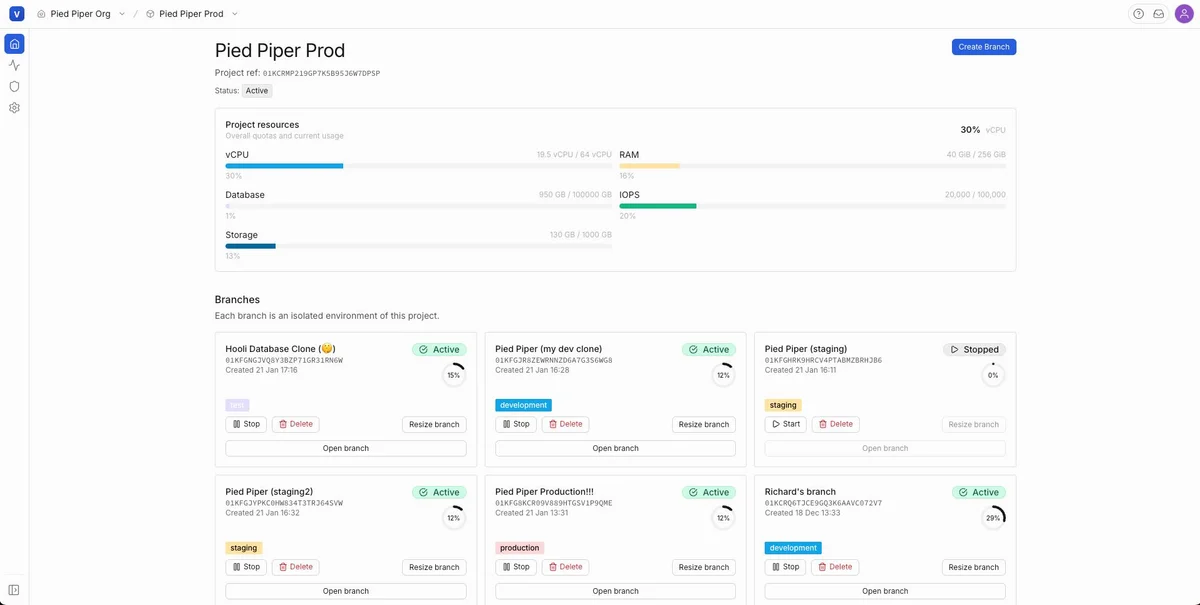
One of Vela's killer features is instant database branching. In just 20 seconds, you can create isolated copies of your database for each feature branch, QA environment, or CI/CD pipeline. Each branch is independent—you can make schema changes, seed different data, or run experiments without affecting production or other environments.
With RDS, this workflow simply doesn't exist. You're limited to manual backup/restore processes that take minutes and consume massive amounts of storage. Vela's copy-on-write architecture means your clones use negligible additional disk space while providing complete isolation.
Platform Capabilities
| Capability | Vela | AWS RDS |
|---|---|---|
| PGREST API | ||
| Visual Schema Editor | ||
| Row Level Security (RLS) | Built-in | |
| Auth Integration | ||
| Instant Snapshots | ||
| Instant Branching |
Enterprise Governance Built In
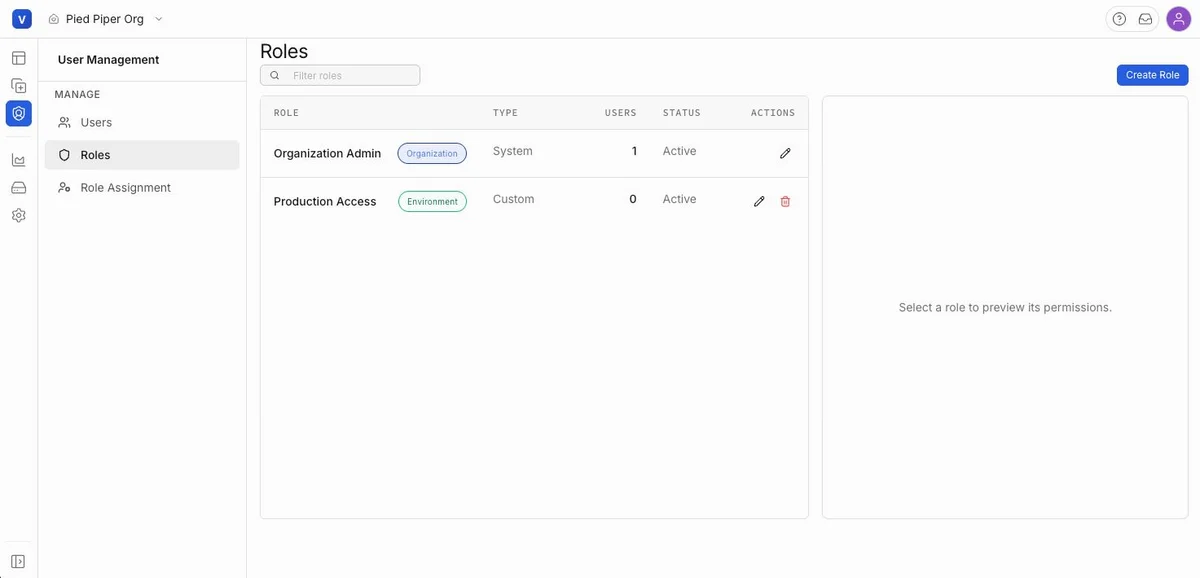
As teams scale, database governance becomes critical. Vela includes hierarchical role-based access control (RBAC) with custom roles, per-branch limits, and separate permission models for Production Access versus Dev/Test environments. This means junior developers can safely work on staging branches without accidentally touching production.
You can define granular policies, enforce resource quotas per branch, and audit all access and changes. RDS offers basic IAM integration, but it's designed for a single production endpoint—not for managing dozens of development branches with different permission levels.
Per-branch Limits
Control resource consumption (CPU, memory, storage) for each branch independently. Prevent runaway queries or rogue scripts from impacting other environments.
Org Admin Controls
Centralized management of users, teams, and permissions across your entire organization. Audit logs track every change for compliance.
Significant Cost Savings
Beyond performance, the cost difference is staggering. Vela's thin cloning approach means you're not duplicating entire databases for each environment. Combined with predictable pricing and no data egress fees, teams see 50–90% savings depending on their workload type.
MIXED WORKLOADS
Savings vs RDS
IOPS-HEAVY OLTP
Massive Savings
UNIT ECONOMICS
TLP-H Benchmarks
Built-in Performance Intelligence
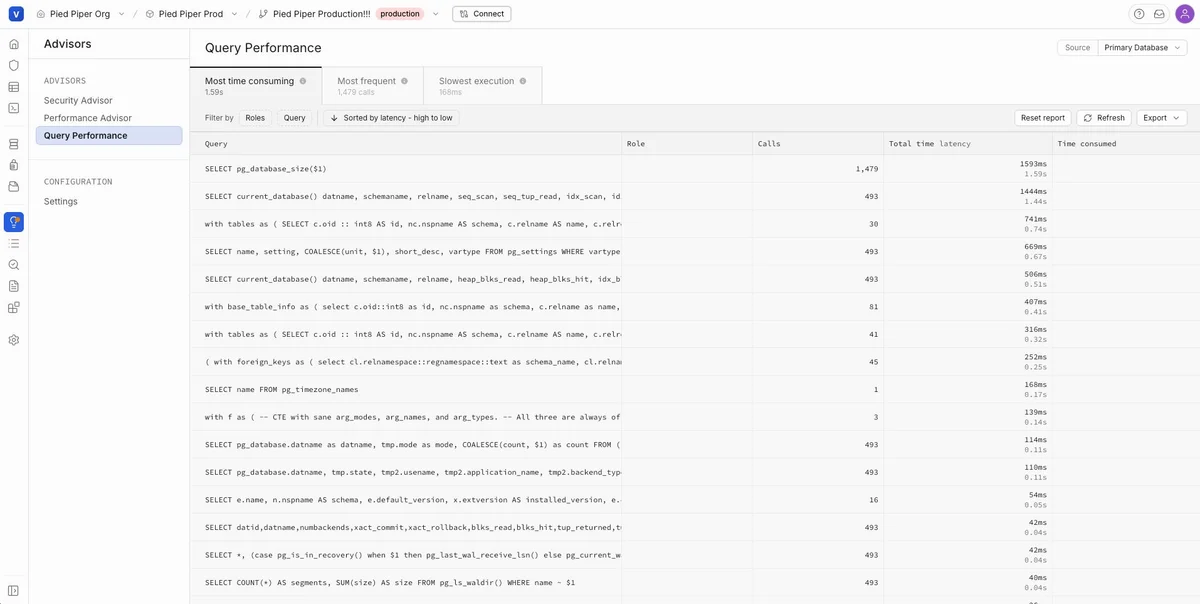
Vela includes a sophisticated query performance monitor and optimization advisor. See exactly which queries are slow, where execution time is spent, and get automatic recommendations for index creation. This eliminates the need for separate monitoring tools and manual performance tuning.
Real-time metrics show you the health of each database branch. Track query patterns, identify N+1 problems, and optimize before deploying to production. RDS has CloudWatch integration, but it requires significant setup and doesn't provide database-specific optimization advice.
Visual Schema Management
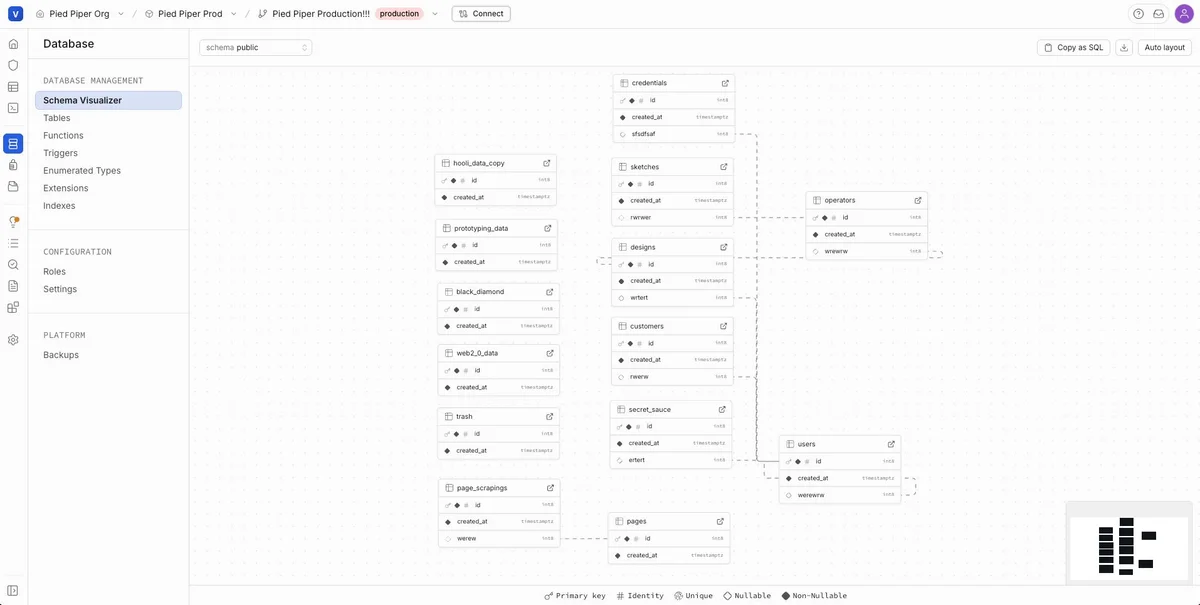
Vela's visual schema editor and entity-relationship diagram (ERD) visualizer let you understand your data model at a glance. Make schema changes visually or through SQL—both are perfectly synchronized. This is invaluable for onboarding new team members and catching design issues early.
Is Vela Right for You?
While Vela is optimized for teams building modern applications with complex development workflows, RDS remains viable for simpler use cases. Use this guide to determine which platform fits your needs.
Choose Vela If You Need:
- Instant database cloning & branching for dev/QA/staging
- Predictable costs without surprise data egress fees
- Git-like workflows and CI/CD integration
- 50+ Postgres extensions out of the box
RDS Might Suffice If:
- You only need a single production database
- Your team is small with no complex workflows
- You're AWS-only with limited cloud flexibility
- Minimal environment duplication requirements
50+ Postgres Extensions Built In
Vela comes with over 50 Postgres extensions pre-installed and ready to use. From spatial databases with PostGIS to time-series data with TimescaleDB, vector embeddings with pgvector, and cryptographic functions with pgcrypto—you have everything needed for modern data applications without extra configuration.
Featured Extensions
Plus: 45+ additional extensions including pgrouting, pgroonga, pg_partman, pg_duckdb, pgaudit, wrappers, vault, hypopg, and more. All ready to enable with a single command.
With RDS, managing extensions is tedious. Some extensions require parameter group changes that need instance restarts. Vela handles all of this seamlessly—enable any extension instantly without downtime, and they work consistently across all your branches (production, staging, dev).
Backup & Point-in-Time Recovery
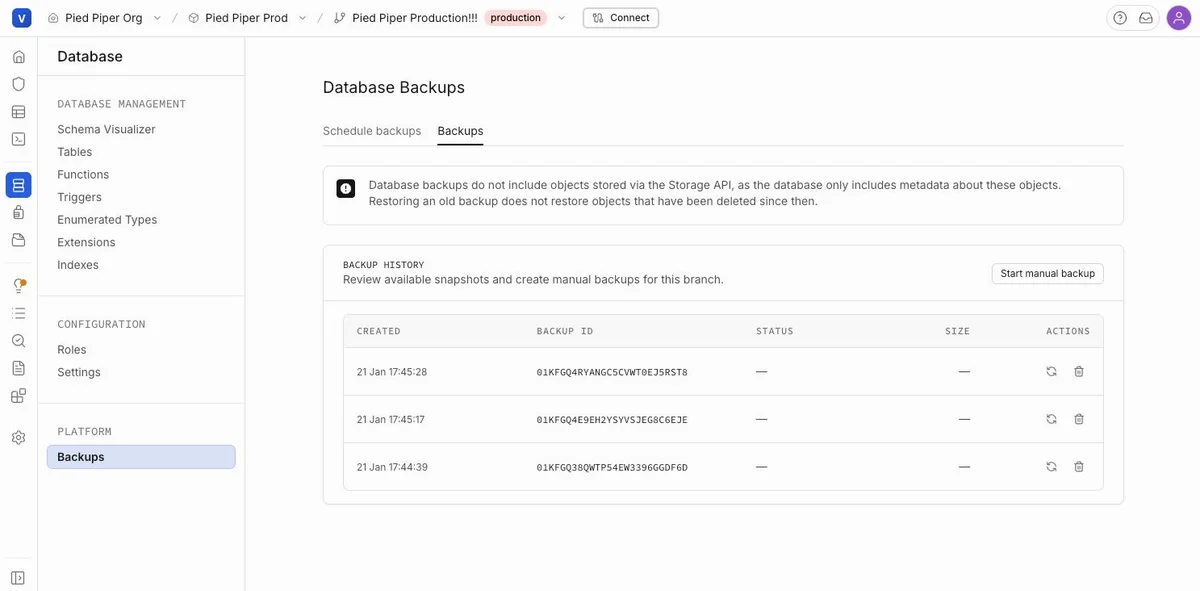
Vela provides instant snapshots and point-in-time recovery in as little as 60 seconds. Recover to any moment in time without restoring to a new instance. Combined with branching, this gives you unprecedented flexibility—create a clone from a backup, debug the issue, then reset without affecting anything else.
Every branch has its own backup schedule and retention policy. This means you can safely run schema migrations, bulk operations, or dangerous scripts with the confidence that you can instantly recover if something goes wrong.
Making the Switch
Migrating from RDS to Vela is straightforward with zero downtime. Vela's BYOC deployment model means it runs directly in your cloud (AWS, GCP, Azure, or on-prem), giving you complete control and portability—something RDS's AWS-only approach can't offer.
Plan & Assess
Analyze your current RDS setup and identify optimization opportunities.
Test in Parallel
Run Vela alongside RDS, validate performance and data consistency.
Gradual Cutover
Migrate traffic incrementally with zero downtime and full visibility.
Frequently Asked Questions
What is the main difference between Vela and AWS RDS?
AWS RDS is a fully managed PostgreSQL service inside AWS — you get automated backups, patching, and scaling, but your data resides in AWS's infrastructure and your team has no control over the storage layer. Vela is a BYOC (Bring Your Own Cloud) platform: the managed control plane runs in your own AWS/GCP/Azure account, giving your team data residency control, instant copy-on-write database cloning, and Git-style branching — capabilities RDS does not provide.
Is Vela faster than AWS RDS?
In published benchmarks, Vela achieves ~290,000 read TPS compared to AWS RDS at ~45,000 TPS under comparable configurations — approximately 6x faster for read-heavy workloads. This is due to Vela's use of Simplyblock's high-performance NVMe-over-Fabrics storage layer, which delivers lower I/O latency than RDS's EBS-backed storage. See the benchmarks page for full methodology.
How much does Vela cost compared to AWS RDS?
Teams typically report 60–80% cost savings after migrating from RDS to Vela. RDS charges for compute (instance hours), storage (GB-month), I/O operations, and data transfer separately — costs scale non-linearly under heavy workloads. Vela's BYOC model means you pay your cloud provider directly for underlying resources at standard rates, plus Vela's platform fee, without the RDS markup on storage I/O. Use the savings calculator for a personalized estimate.
Does Vela support database branching like Neon?
Yes. Vela provides copy-on-write instant database cloning — any database branch is created in seconds regardless of size. This is comparable to Neon's branching feature, but Vela runs in your own cloud (BYOC) rather than in Neon's infrastructure. AWS RDS has no equivalent — cloning an RDS database requires a full snapshot restore, which can take 10–60 minutes for large databases.
How difficult is it to migrate from AWS RDS to Vela?
Migration from RDS to Vela follows standard PostgreSQL migration steps since both use vanilla PostgreSQL. The typical process: (1) provision a Vela instance in your cloud; (2) use pg_dump/pg_restore or logical replication for data migration; (3) run both in parallel to validate; (4) cut over with a brief maintenance window. Since Vela uses standard PostgreSQL, your existing queries, extensions, and tooling all work without modification.
Ready to Switch from RDS?
Join teams already using Vela for faster development, production-grade reliability, and predictable costs.