Vela is a Postgres data platform for teams that need production-like database environments without turning every test, migration, or AI experiment into a manual restore project. It keeps PostgreSQL semantics familiar while adding a workflow layer for branches, clones, and operational control.
The point is not to introduce a new SQL dialect or hide core Postgres behavior. The point is to make database lifecycle operations easier to repeat, easier to govern, and less dependent on shared staging databases.
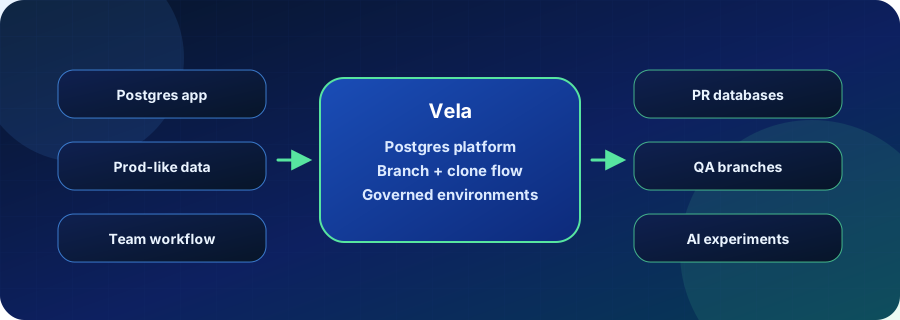
What Vela Provides
Vela provides a Postgres-first workflow around database branching, cloning, and production-like test environments. Application code still talks to Postgres, and teams still need to understand SQL, indexes, WAL, MVCC, and recovery behavior.
The platform layer matters because many teams already know how to run a single Postgres instance but struggle to make safe copies of production-like data available to developers, QA, and migration pipelines. Vela turns those lifecycle tasks into repeatable workflows rather than one-off scripts.
Where Teams Use Vela
Vela is useful when the database environment becomes a release bottleneck. That usually happens when a single shared staging database drifts, dump and restore takes too long, or developers cannot validate schema changes against realistic data before merging code.
Common patterns include:
- branch-per-PR testing for application changes
- isolated QA databases for regression suites
- schema migration rehearsals before production rollout
- AI and analytics experiments against controlled data copies
- self-serve Postgres environments with platform guardrails
Need production-like Postgres environments without staging contention? Use Vela to create isolated branches and clones for development, QA, AI experiments, and migration tests. See how Vela works
Vela vs Managed Postgres vs Shared Staging
Vela should be compared to the workflow it replaces, not only to a database server. The practical question is how teams create, test, govern, and clean up database environments.
| Approach | Primary model | Best fit | Common limitation |
|---|---|---|---|
| Self-managed Postgres | Team operates the full stack | Teams with deep DBA and platform capacity | Branching and clone workflows usually require custom tooling |
| Managed DBaaS | Vendor manages the database service | Production database hosting | Dev and QA workflows still often depend on restores or shared staging |
| Shared staging database | One environment used by many teams | Small teams with simple release flows | Data drift and coordination problems grow over time |
| Vela | Postgres platform with branches and clones | Production-like development, QA, and migration validation | Requires clear branch access, cleanup, and promotion rules |
How Vela Fits a Postgres Team
Vela fits best when platform teams want to standardize Postgres workflows without taking away the database model developers already know. It is a platform around PostgreSQL operations, not a replacement for understanding PostgreSQL itself.
That makes it relevant to teams working on database branching, branch-per-PR pipelines, testing against production-like data, and operational reviews where repeatability matters more than one-off restores.
Operational Checks
Before relying on Vela as a standard workflow, verify the operating model:
- decide which baselines can be used for branches and clones
- define branch access rules, data handling rules, and retention windows
- test schema migrations against production-like data before rollout
- measure branch growth and cleanup behavior over time
- document who owns branch creation, promotion, and deletion
Related Vela Reading
Start with How Vela Works, Database Branching, Branch per PR, and the Vela articles library. For adjacent glossary terms, review Unified Database, Database Branching, Copy-on-Write (COW), Clone (Database Clone).