Vector search is a search method that compares embedding vectors to find semantically similar items. Instead of matching only exact words, it can find records that are close in meaning, which makes it important for AI retrieval and recommendation workflows.
In Postgres environments, vector search usually sits next to transactional data, metadata, permissions, and application logic. That means teams need to test not just the vector index, but also the surrounding relational workflow.
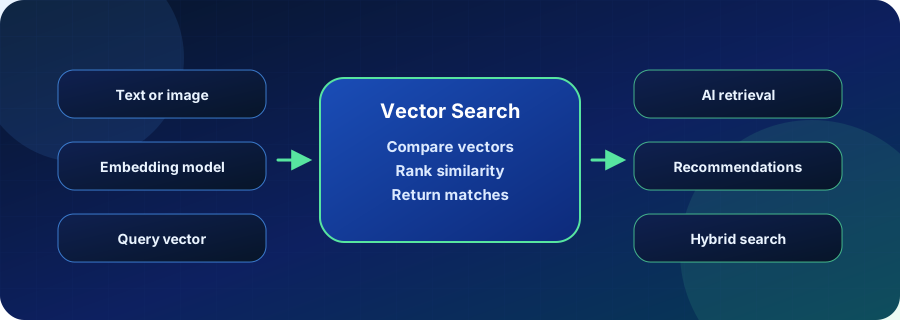
How Vector Search Works
Vector search starts by transforming content into numerical embeddings. A query is also transformed into an embedding, and the search process returns records with nearby vectors according to a distance metric.
In a Postgres-centered stack, vector search often combines semantic similarity with relational filters, permissions, freshness rules, and application-specific metadata. That hybrid context is why production-like testing matters.
Where Teams Use Vector Search
Teams use vector search for AI assistants, semantic retrieval, recommendations, document search, product discovery, and support workflows. It becomes more useful when it can work with existing relational data rather than a disconnected copy.
Common patterns include:
- retrieval-augmented generation over product data
- semantic search across documents or support cases
- recommendations using embeddings and relational filters
- AI feature testing against production-like data
- hybrid search that combines keywords, filters, and vectors
Need to test AI data workflows before production rollout? Vela branches let teams validate vector-search changes, data refreshes, and schema updates in isolated Postgres environments. Explore Postgres for AI applications
Vector Search vs Keyword and Hybrid Search
Vector search is powerful, but it is often best when combined with relational filters and keyword behavior.
| Approach | How it matches | Best fit | Common limitation |
|---|---|---|---|
| Keyword search | Matches terms and text patterns | Exact terms, names, filters | Misses semantic similarity |
| Vector search | Ranks by embedding similarity | AI retrieval and recommendations | Needs embedding and index quality |
| Hybrid search | Combines keywords, vectors, and filters | Production AI search workflows | More moving parts to test |
| Vela branch | Tests search changes in [isolation](/glossary/isolation/) | AI workflow validation | Requires production-like data and cleanup rules |
How Vector Search Relates to Vela
Vela is relevant to vector search because AI features often require schema changes, embedding refreshes, new indexes, and careful testing against realistic data. A branch gives the team a safer place to validate those changes.
This is especially useful when vector search sits next to transactional Postgres data and application permissions. Teams can test behavior before changing the production path.
Operational Checks
Before shipping vector search changes, verify:
- embedding model and refresh process are documented
- index choices are tested against realistic data size
- relational filters and permissions are applied correctly
- query latency and result quality are measured together
- branch tests include schema, index, and data refresh changes
Related Vela Reading
Start with How Vela Works, Database Branching, Branch per PR, and the Vela articles library. For adjacent glossary terms, review Unified Database, HTAP (Hybrid Transactional/Analytical Processing), OLTP (Online Transaction Processing), OLAP (Online Analytical Processing).