A unified database is an architecture idea: keep more data workflows close to a common database foundation instead of splitting every new need into a separate system. In a Postgres context, that often means using PostgreSQL for transactional data while extending workflows around analytics, search, AI, and testing.
The goal is not to force one database to do everything. The goal is to reduce unnecessary copies, mismatched pipelines, and duplicated governance where a common Postgres-based workflow is enough.
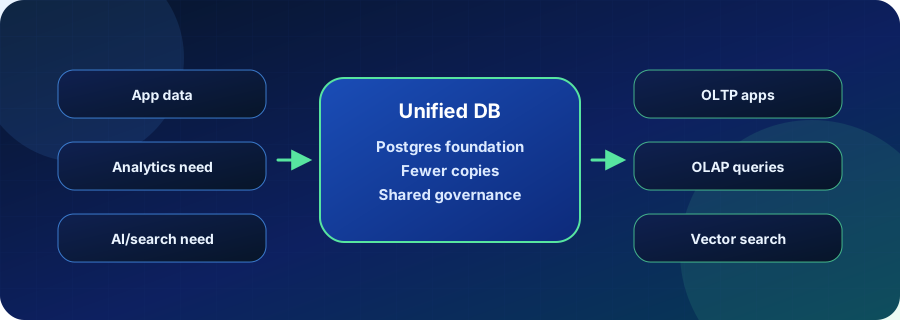
How a Unified Database Works
A unified database strategy starts with a shared foundation for the core data model. From there, teams decide which workloads can stay near that foundation and which ones still need specialized systems.
Postgres is often a strong foundation because it supports transactions, indexing, JSON, extensions, full-text search, and ecosystem tooling. The hard part is not capability alone; it is operational discipline around workload isolation and testing.
Where Teams Use Unified Database Patterns
Teams consider unified database patterns when data movement becomes a product or operations bottleneck. If every feature requires another pipeline, another copy, and another governance process, the system becomes harder to reason about.
Common patterns include:
- reducing staging and analytics copies
- testing AI features near relational data
- combining transactional and analytical review workflows
- keeping branch-based development close to production-like data
- simplifying governance for Postgres-centered teams
Need fewer database copies without losing workflow control? Vela helps Postgres teams create branches and controlled environments around a more unified data workflow. Explore unified Postgres
Unified Database vs Specialized Database Sprawl
A unified database strategy is a design choice, not a claim that specialization never matters.
| Approach | How it works | Best fit | Common limitation |
|---|---|---|---|
| Specialized systems | Separate database per workload | Clear workload specialization | More pipelines, copies, and governance surfaces |
| Warehouse copy | Move data for analytics | Large historical analytics | Freshness and pipeline complexity |
| Unified database | Keep more workflows near one foundation | Postgres-centered product teams | Needs workload boundaries |
| Vela workflow | Branches and clones around Postgres | Dev, QA, AI, analytics validation | Requires lifecycle and access rules |
How Unified Database Relates to Vela
Vela supports a Postgres-centered workflow where branches and clones make it easier to test changes against realistic data. That makes a unified database strategy more practical because teams can validate work before moving it into shared paths.
Vela should still be used with clear boundaries: not every workload belongs on the same hot path, and branch-based testing should inform those decisions.
Operational Checks
Before moving toward a unified database model, verify:
- which workloads can safely share the Postgres foundation
- where analytics or AI workloads need isolation
- how branches validate query and schema changes
- how data governance applies across workflows
- when a specialized system remains the right choice
Related Vela Reading
Start with How Vela Works, Database Branching, Branch per PR, and the Vela articles library. For adjacent glossary terms, review HTAP (Hybrid Transactional/Analytical Processing), OLTP (Online Transaction Processing), OLAP (Online Analytical Processing), Vector Search.