Sovereign Postgres describes PostgreSQL environments designed around data sovereignty, residency, and operational control requirements. It matters when teams need to know where data lives, who can access it, and which operational systems can affect it.
The term is often reduced to region selection, but that is too narrow. Sovereignty can involve control planes, backups, logs, administrative access, support paths, encryption keys, and the lifecycle of temporary database branches or clones.
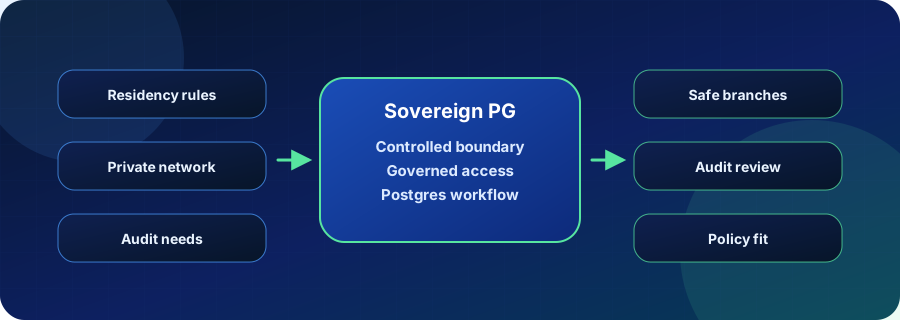
What Sovereign Postgres Means
A sovereign Postgres model keeps database data and operational workflows inside boundaries that match policy, jurisdiction, or enterprise control requirements. This can include deployment location, access management, backup storage, observability data, and support procedures.
For development and QA, sovereignty also affects branches and clones. If a branch uses production-like data, it should inherit the same data handling expectations as the source environment.
Where Teams Use Sovereign Postgres
Teams use sovereign Postgres in regulated industries, public sector, sovereign AI programs, private cloud deployments, and enterprises with strict data handling requirements.
Common patterns include:
- keeping Postgres data inside approved jurisdictions
- building private-cloud database workflows for regulated teams
- controlling access to production-like branches and clones
- validating recovery without moving data outside policy boundaries
- aligning AI and analytics experiments with data sovereignty rules
Need Postgres workflows that respect sovereignty boundaries? Vela helps teams reason about branches, clones, and production-like environments without hiding PostgreSQL semantics. Explore sovereign AI workflows
Sovereign Postgres vs Region-Based Hosting
Sovereignty is broader than region placement. It also covers operational control and lifecycle data flows.
| Approach | Boundary focus | Best fit | Common limitation |
|---|---|---|---|
| Region-based hosting | Data placed in a selected region | Basic residency needs | May ignore control planes and logs |
| Public DBaaS | Vendor-managed operations | Fast managed database use | Operational access may not fit strict rules |
| Sovereign Postgres | Data and operations boundary | Regulated and sovereign workloads | Needs policy-aware operations |
| Vela workflow | Postgres lifecycle controls | Branches, clones, and governed testing | Requires data handling rules |
How Sovereign Postgres Relates to Vela
Vela is relevant because database branches, clones, and test environments must respect the same control assumptions as production. A useful platform workflow should make those rules repeatable rather than relying on tribal knowledge.
Vela keeps PostgreSQL behavior familiar while giving teams a way to standardize lifecycle workflows inside controlled environments.
Operational Checks
Before adopting sovereign Postgres workflows, verify:
- where data, backups, logs, and branch deltas are stored
- which identities can access production-like branches
- how control-plane and support access are governed
- whether AI and analytics experiments use approved data paths
- how retention and deletion rules apply to temporary environments
Related Vela Reading
Start with How Vela Works, Database Branching, Branch per PR, and the Vela articles library. For adjacent glossary terms, review Private Cloud Postgres, BYOC (Bring Your Own Cloud), Serverless Postgres On-Prem, Vela.