RAG with Postgres means using PostgreSQL as part of a retrieval-augmented generation workflow. Postgres can store documents, metadata, permissions, embeddings, source records, or application context that an AI system retrieves before generating a response.
The value is not only storing vectors. RAG systems often need relational filters, tenant boundaries, freshness rules, and auditability around the retrieved data. That makes Postgres a practical foundation when the AI feature is tied to application state.
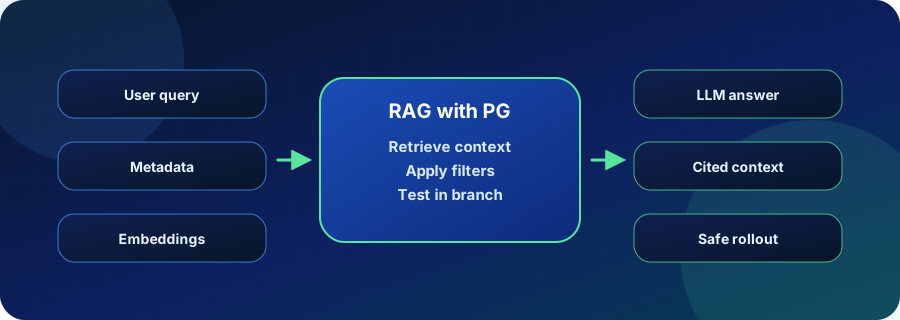
How RAG with Postgres Works
A RAG workflow retrieves relevant context before sending a prompt to a model. With Postgres, that context may come from relational tables, vector indexes, full-text search, JSON metadata, permissions tables, or a combination of those paths.
Teams should test retrieval behavior with production-like data because toy datasets rarely expose tenant filtering errors, stale embeddings, weak metadata, or query-cost problems.
Where Teams Use RAG with Postgres
Teams use RAG with Postgres for product assistants, internal knowledge tools, support copilots, semantic search, code or documentation assistants, and AI workflows that need application-specific context.
Common patterns include:
- combining vector search with relational filters
- testing prompt retrieval against production-like data
- validating embedding refreshes before rollout
- checking tenant and permission filters
- branching a database before changing AI data pipelines
Need to test RAG changes against realistic Postgres data? Vela branches let teams validate retrieval, filters, embeddings, and schema changes before shipping AI features. Explore Vela for AI applications
RAG with Postgres vs Standalone Vector Store
A standalone vector database may be useful, but many production RAG systems need relational context too.
| Approach | Context model | Best fit | Common limitation |
|---|---|---|---|
| Standalone vector store | Embeddings-first retrieval | Specialized semantic search | Can drift from application data and permissions |
| Postgres relational search | Tables, filters, and full-text search | Structured application context | May need vector extension or hybrid design |
| RAG with Postgres | Vectors plus relational context | AI features tied to app data | Needs query and refresh testing |
| Vela branch workflow | RAG validation in an isolated branch | Safe rollout of AI data changes | Requires branch lifecycle rules |
How RAG with Postgres Relates to Vela
Vela is relevant because RAG changes affect data, schema, embeddings, permissions, and query behavior. A branch lets teams validate the full retrieval workflow against production-like data without changing the main database.
That makes it easier to test AI features with realistic context while keeping rollout risk contained.
Operational Checks
Before shipping RAG with Postgres, verify:
- how embeddings are generated, refreshed, and versioned
- whether tenant and permission filters apply before context reaches the model
- query latency and recall on production-like data
- how branch tests cover schema and data pipeline changes
- how outputs are audited and rolled back if retrieval changes regress
Related Vela Reading
Start with Postgres for AI Applications, Agentic Databases, Database Branching, and the Vela articles library. For adjacent glossary terms, review Vector Search, Postgres Vector Database, AI Data Governance for Postgres, Postgres for AI Agents.