Prepared statements are how PostgreSQL separates the structure of a query from the data it operates on. The query text is parsed and validated once; parameter values are supplied later at execution time. That separation is what makes SQL injection structurally impossible and what reduces per-query overhead for frequently repeated operations.
The security benefit is unconditional. The performance benefit is real but nuanced — plan caching helps repeated identical queries, but it can hurt queries where the optimal plan changes significantly with different parameter values.
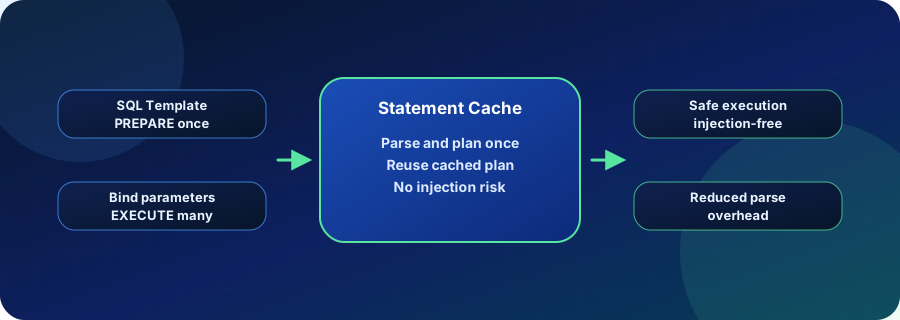
What Prepared Statements Are
The SQL interface to prepared statements uses three commands:
PREPARE get_order(int) AS
  SELECT * FROM orders WHERE id = $1;

EXECUTE get_order(1042);

DEALLOCATE get_order;
When PostgreSQL receives the PREPARE command, it parses the query and checks it against the current schema. For simple queries it may defer planning until the first EXECUTE; for complex queries it plans immediately. The plan is stored in session memory under the statement name.
Plan caching behavior is controlled by plan_cache_mode:
auto(default): PostgreSQL uses a generic plan after five executions if it is consistently cheaper than generating a custom plan for each parameter set.force_generic_plan: Always use the generic plan. Reduces planning overhead but can hurt queries where parameter values have very different selectivity.force_custom_plan: Always plan at execution time. Optimal plan quality but more planning overhead.
Most application drivers do not use explicit PREPARE/EXECUTE SQL. They use the PostgreSQL extended query protocol, which sends Parse, Bind, and Execute messages separately. The effect is the same: the query is parsed once and parameters are bound at execution time.
Where Prepared Statements Matter in Practice
ORM-generated queries: Most ORMs (SQLAlchemy, ActiveRecord, Hibernate, Prisma) use parameterized queries by default through the extended query protocol. The application developer rarely writes explicit PREPARE statements, but the driver is handling parameterization automatically.
Agent-generated SQL: AI agents that construct SQL from user input or retrieved context must pass all external values as parameters. String interpolation — building the query by concatenating values into the SQL text — bypasses the injection protection that prepared statements provide.
High-frequency inserts: Bulk ingestion pipelines that run the same INSERT statement thousands of times per second benefit from prepared statements because the parse and plan cost is paid once. The difference is measurable on high-throughput insert workloads.
Test schema changes that affect prepared statement plans in a Vela branch before production deployment. Try Database Branching
Why Prepared Statements Matter for Production Postgres
SQL injection prevention: Parameterized execution makes it structurally impossible for a parameter value to alter query semantics. This is the most reliable defense available and does not depend on input validation or escaping logic.
Plan caching and parse overhead: For workloads where the same logical query executes thousands of times per minute with different parameter values, eliminating repeated parse and plan cycles reduces CPU overhead on the database server. The savings are most visible for short, frequent queries where planning time is a significant fraction of total execution time.
PgBouncer transaction mode compatibility: This is the most operationally important consideration for teams using connection poolers. PgBouncer in transaction pooling mode does not preserve server-side session state between transactions. A named prepared statement created in one transaction is not guaranteed to be available in the next if the connection is reassigned. Drivers must be configured to use inline parameter binding (which does not rely on server-side statement names) when running behind a transaction-mode pooler.
Ad-Hoc vs Prepared vs ORM Parameterized Queries
| Approach | SQL injection risk | Parse overhead | Pooler compatibility | Best fit |
|---|---|---|---|---|
| Ad-hoc queries (string concat) | High — user input in SQL text | Full parse + plan every call | Full compatibility | Internal scripts with no external input |
| Server-side prepared statements (PREPARE) | None — params bound separately | Parse once per session | Session pooling only | Long-lived sessions, repeated identical queries |
| Extended query protocol (driver-level) | None — params bound at wire level | Parse once, driver-managed | Works with transaction pooling if using inline bind | Application drivers, ORMs, agent-generated SQL |
| ORM parameterized queries | None — ORM handles binding | Driver-managed caching | Depends on driver and pooler configuration | Standard application development |
How Prepared Statements Relate to Vela
Schema changes that add or remove columns, change column types, or alter index definitions can invalidate cached query plans. In PostgreSQL, a prepared statement that references a modified schema object is automatically invalidated and re-planned on the next EXECUTE. However, the new plan may not behave as expected — particularly if a migration drops an index that the prepared statement was relying on.
Vela branches give teams a safe place to apply schema migrations and verify that the affected prepared statement plans remain efficient before promoting the migration to production. Running the application query suite against a branch with the new schema, and checking EXPLAIN ANALYZE output for plan regressions, catches these issues before they affect live traffic.
Operational Checks
- Confirm application drivers use parameterized queries, not string concatenation, for any user-supplied values.
- Check whether your connection pooler mode is compatible with server-side prepared statement names.
- Review
plan_cache_modeif queries with widely varying parameter selectivity are showing plan instability. - After schema migrations, verify that frequently-used prepared statement plans are still using the expected indexes.
- Audit AI agent and scripting code for any SQL construction that bypasses parameterized execution.
Related Vela Reading
Start with How Vela Works, Database Branching, Branch per PR, and the Vela articles library. For adjacent glossary terms, review Connection Pooling, Transaction, Row-Level Security, and Query Execution Plan.