Postgres for AI agents means using PostgreSQL as a durable data layer for agentic applications, retrieval workflows, tool calls, and AI-driven product features. Agents often need access to live or production-like context, but that access has to be controlled.
The operational problem is not only vector search. Agents may test migrations, generate SQL, inspect application state, or run workflows that depend on realistic data. That makes isolated branches and clones important for safety.
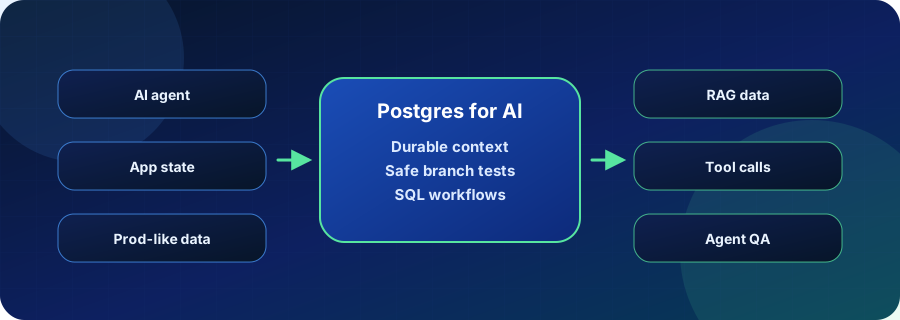
What Postgres for AI Agents Means
Postgres can support AI agents by storing application state, metadata, permissions, embeddings, audit records, and workflow results. The agent may query Postgres directly, call tools that use Postgres, or operate over a branch of the database.
The key risk is unsafe experimentation. Agents and AI features should be tested against production-like data without giving them unrestricted write access to production.
Where Teams Use Postgres for AI Agents
Teams use Postgres for AI agents when building internal copilots, product assistants, retrieval-augmented generation, workflow automation, AI QA, and data-heavy agent tools that need reliable operational context.
Common patterns include:
- testing agent-generated SQL against a database branch
- validating embedding refreshes and retrieval behavior
- running AI experiments against production-like data safely
- keeping audit and application state in a familiar database
- isolating agent workflows before production rollout
Need safe Postgres environments for AI agent workflows? Vela branches let teams validate agent, SQL, and data workflows against production-like Postgres without using production as the test bed. Explore Postgres for AI applications
Postgres for AI Agents vs Standalone Vector Database
AI agents often need more than embeddings. They need relational context, permissions, state, and safe test environments.
| Approach | What it provides | Best fit | Common limitation |
|---|---|---|---|
| Standalone [vector database](/glossary/postgres-vector-database/) | Embedding search store | Specialized semantic retrieval | Often separate from relational state |
| Application database only | Transactional app data | Core product workflows | AI experiments can risk production |
| Postgres for AI agents | Relational state plus AI workflow context | Agentic applications and RAG with governance | Needs query and access design |
| Vela branch workflow | Isolated production-like Postgres environments | Agent QA, SQL tests, and data experiments | Requires branch retention and permissions |
How Postgres for AI Agents Relates to Vela
Vela is relevant because AI agents need safe, realistic places to test database behavior. A Vela branch can provide production-like Postgres context while keeping writes and experiments isolated from the main database.
This helps teams validate agent-generated SQL, retrieval changes, schema updates, and AI product workflows before production rollout.
Operational Checks
Before giving AI agents access to Postgres workflows, verify:
- which data the agent can read and write
- whether tests run in a branch rather than production
- how generated SQL is reviewed and constrained
- how embeddings and metadata are refreshed and validated
- how audit, rollback, and branch cleanup are handled
Related Vela Reading
Start with How Vela Works, Database Branching, Branch per PR, and the Vela articles library. For adjacent glossary terms, review Vector Search, Postgres Data Platform, Unified Database, Vela.