A Postgres data platform is more than a single PostgreSQL database. It is a platform layer around Postgres that helps teams create, test, govern, and operate database environments across development, QA, analytics, AI, and production workflows.
The point is not to make PostgreSQL unrecognizable. The point is to preserve familiar PostgreSQL behavior while making the surrounding lifecycle easier to use and easier to standardize.
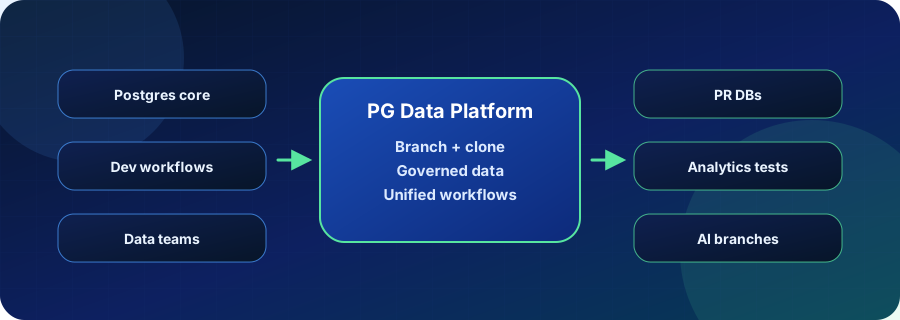
What a Postgres Data Platform Means
A Postgres data platform wraps platform workflows around PostgreSQL. Those workflows can include branch creation, cloning, recovery validation, query testing, analytics experiments, AI data access, access control, and cleanup.
The database still matters. Transactions, WAL, MVCC, indexes, and query planning remain part of the system. The platform adds repeatable lifecycle operations so teams do not have to rebuild them for every project.
Where Teams Use Postgres Data Platforms
Teams use Postgres data platforms when Postgres becomes the center of application data, analytics, AI, and developer workflows. A platform model helps reduce duplicate systems and manual database processes.
Common patterns include:
- branch-per-PR database development
- QA and migration testing against production-like data
- unified OLTP and analytics workflow validation
- AI experiments near relational data
- governed private-cloud Postgres operations
Need a Postgres platform rather than another standalone database? Vela focuses on Postgres branches, clones, and governed lifecycle workflows for developer and platform teams. Explore unified Postgres
Postgres Data Platform vs Standalone Postgres
A platform model focuses on repeatable workflows around the database, not only the database process itself.
| Approach | What it provides | Best fit | Common limitation |
|---|---|---|---|
| Standalone Postgres | One database or cluster | Focused application workloads | Lifecycle workflows are often manual |
| Managed DBaaS | Hosted operational database service | Simple production hosting | Dev and QA workflows can remain separate |
| Postgres data platform | Workflows around PostgreSQL | Cross-team data lifecycle standardization | Requires governance and ownership |
| Vela workflow | Branches, clones, and Postgres lifecycle | Developer, QA, AI, and migration workflows | Needs retention and access rules |
How a Postgres Data Platform Relates to Vela
Vela describes itself as a Postgres data platform because its value is in the workflows around PostgreSQL: production-like branches, clones, QA environments, AI experiments, and controlled platform operations.
That makes it different from a single database instance or a generic hosting service. The focus is on making Postgres easier to use safely across teams.
Operational Checks
Before adopting a Postgres data platform, verify:
- which teams need branch and clone workflows
- how production-like data is governed in non-production environments
- how OLTP, analytics, and AI workflows are separated or validated
- how backup and recovery validation fit the platform model
- how lifecycle cleanup and cost visibility are handled
Related Vela Reading
Start with How Vela Works, Database Branching, Branch per PR, and the Vela articles library. For adjacent glossary terms, review Database Platform Engineering, Unified Database, Postgres for AI Agents, Vela.