pg_restore is the PostgreSQL utility for restoring custom-format, directory-format, or tar-format archives created by pg_dump. It can restore an entire database or selected objects, which makes it useful for migrations and controlled restore tasks.
For teams building developer environments, the key question is whether pg_restore is the right workflow. It is reliable, but repeated logical restore cycles can become slow, fragile, and hard to coordinate at production scale.
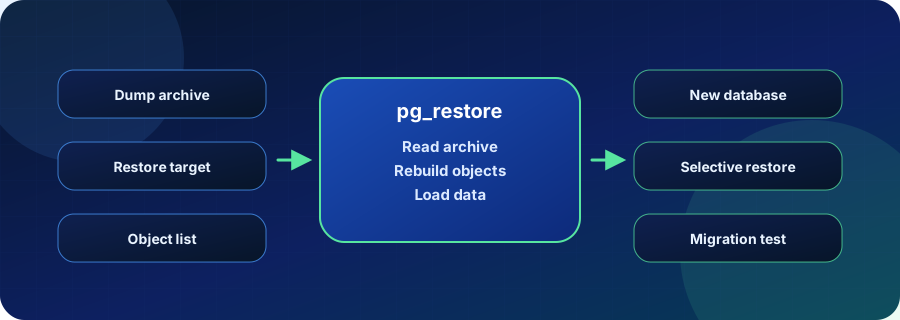
How pg_restore Works
pg_restore reads an archive produced by pg_dump and recreates database objects and data in a target PostgreSQL environment. It can restore selectively, run in parallel for some formats, and give operators more control than plain SQL restore.
Because it is logical, pg_restore rebuilds the database from exported definitions and rows. That is different from physical recovery, where a base backup and WAL reconstruct the cluster state.
Where Teams Use pg_restore
Teams use pg_restore when they need to restore a pg_dump archive, migrate data into a new environment, recover selected objects, or validate that a logical backup is usable. It is also common in CI scripts, although it may become a bottleneck as data size grows.
Common patterns include:
- restoring a custom-format pg_dump archive
- selectively restoring a schema or table
- testing database migrations in a new environment
- validating a logical backup before relying on it
- moving data between PostgreSQL versions or environments
Using restores as your default test database workflow? Vela branches give teams a production-like Postgres environment without making every QA run wait on a logical restore. See Vela database branching
pg_restore vs Restore Drill vs Vela Branch
pg_restore is a utility. The larger question is which operational workflow the team is trying to support.
| Approach | What it does | Best fit | Common limitation |
|---|---|---|---|
| pg_restore | Restores a pg_dump archive | Logical migration and selective restore | Can be slow at production size |
| [PITR](/glossary/pitr-point-in-time-recovery/) restore | Replays WAL to a target time | Incident recovery to a precise point | Requires WAL coverage and restore rehearsal |
| Shared staging refresh | Restores into one shared environment | Small teams and occasional tests | Drift and contention accumulate |
| Vela branch | Creates an isolated writable environment | PR, QA, AI, and migration validation | Needs branch retention and access rules |
How pg_restore Relates to Vela
Vela does not remove the need for pg_restore in logical backup and migration workflows. Instead, it gives teams another path when the real need is an isolated, production-like database for testing.
If a team is using pg_restore mainly to refresh staging or create temporary test databases, Vela branches can provide a more repeatable workflow with less restore orchestration.
Operational Checks
Before relying on pg_restore, validate:
- the archive format and PostgreSQL version compatibility
- required extensions, roles, and permissions in the target environment
- restore duration with production-scale data
- whether selective restore behaves as expected
- whether branch-based testing would be a better fit for frequent workflows
Related Vela Reading
Start with How Vela Works, Database Branching, Branch per PR, and the Vela articles library. For adjacent glossary terms, review pg_dump, pg_basebackup, Restore, Database Branching.