Copy-on-write (COW) is a data management pattern where a copy starts by sharing existing data and only stores new data when something changes. For Postgres teams, the practical value is that large database clones and branches can be created without immediately duplicating every block of data.
COW is not a replacement for PostgreSQL correctness. It is a lower-level mechanism that can make higher-level workflows like database branching, QA branches, and migration rehearsals faster and less wasteful.
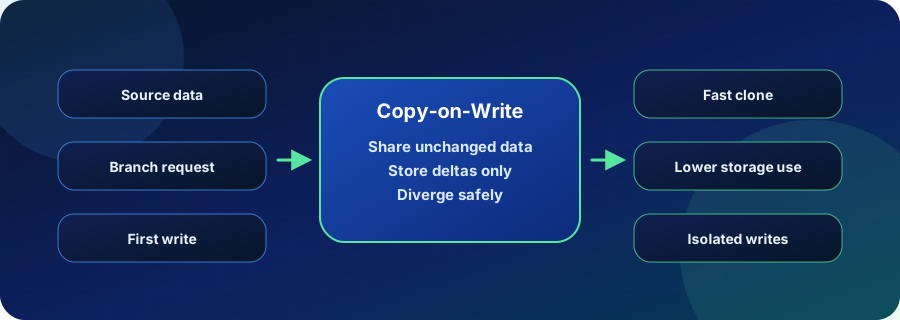
How Copy-on-Write Works
A copy-on-write clone initially points at the same underlying data as its source. Reads can use the shared baseline, while writes are recorded separately for the clone or branch that made the change.
As a branch diverges, only changed data has to be stored for that branch. This is why COW behavior is important for production-like database workflows: the first copy can be lightweight, while the cost grows with actual change volume rather than total database size.
Where Teams Use Copy-on-Write
COW shows up whenever teams need realistic test data without waiting for a full copy. It is especially useful when developers, QA, or migration pipelines need isolated writeable databases that start from the same trusted baseline.
Common patterns include:
- database branches for pull requests
- temporary clones for QA and bug reproduction
- migration tests against production-like data
- safe experiments for analytics and AI features
- short-lived environments that are removed after validation
Need fast Postgres branches without full-copy staging sprawl? Vela uses copy-on-write style workflows so teams can create isolated database branches from production-like baselines. See Vela database branching
Copy-on-Write vs Full Copies and Snapshots
The main difference is when data is duplicated. COW delays duplication until a branch actually changes data, while full copies pay the copy cost up front.
| Approach | How it stores data | Best fit | Common limitation |
|---|---|---|---|
| Full database copy | Duplicates the dataset up front | Small databases and one-off copies | Slow and expensive for large datasets |
| Logical dump and restore | Exports and imports SQL-level data | Portable migrations and backups | Not ideal for branch-per-PR workflows |
| Storage snapshot clone | Shares a storage snapshot until change | Infrastructure-led clone workflows | Often lacks developer-facing lifecycle |
| COW database branch | Shares baseline and stores branch deltas | Production-like dev, QA, and [migration testing](/vela-ci-cd-testing/) | Requires branch cleanup and data access rules |
How Copy-on-Write Relates to Vela
Vela uses copy-on-write style behavior to make production-like Postgres branches and clones practical for everyday development and QA. Developers can work with an isolated branch while unchanged data remains tied to a trusted baseline.
The result is a more useful workflow than a single shared staging database: teams can run migrations, test changes, and discard branch-specific writes without coordinating a full environment reset.
Operational Checks
Before standardizing on copy-on-write workflows, verify the operational boundaries:
- define which source databases can be used as branch baselines
- track storage growth as branches diverge
- set retention policies for temporary branches and clones
- validate cleanup behavior in CI and QA pipelines
- confirm data access and masking rules before exposing production-like data
Related Vela Reading
Start with How Vela Works, Database Branching, Branch per PR, and the Vela articles library. For adjacent glossary terms, review Database Branching, Clone (Database Clone), Vela, BYOC (Bring Your Own Cloud).