Connection pooling is the practice of reusing database connections instead of opening a new PostgreSQL connection for every application request. It matters because Postgres connections are real server resources, and uncontrolled connection growth can hurt performance or stability.
Pooling sounds simple, but the operating details matter. Session pooling, transaction pooling, prepared statements, migrations, and long-running transactions can behave differently depending on the pooler configuration.
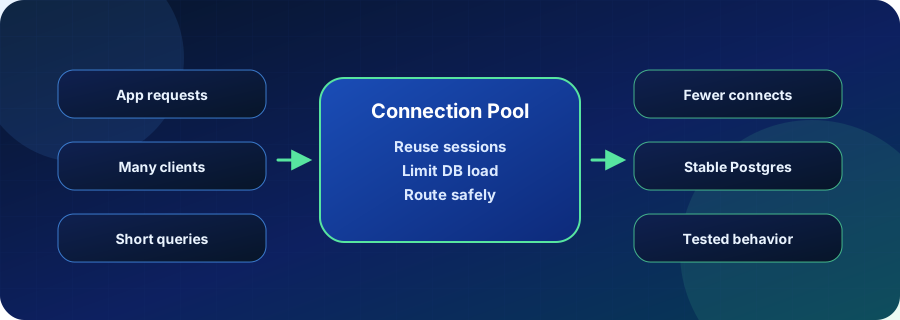
How Connection Pooling Works
A connection pooler sits between applications and PostgreSQL. Applications connect to the pooler, and the pooler reuses a controlled number of server-side database connections.
The exact behavior depends on pooling mode. Session pooling keeps a backend connection associated with a client session, while transaction pooling can reuse backend connections after each transaction. That difference can affect prepared statements, session variables, temporary tables, and migration tooling.
Where Teams Use Connection Pooling
Teams use connection pooling when application concurrency grows faster than PostgreSQL connection capacity. It is also common in serverless and microservice environments where many application instances can create bursts of connections.
Common patterns include:
- protecting Postgres from connection storms
- supporting many application workers or tenants
- reducing connection setup overhead
- testing pooler behavior for migrations and prepared statements
- setting safe limits for development and QA branches
Need to test pooler-sensitive app behavior safely? Use Vela branches to validate migrations, prepared statements, and workload behavior before changing production connection paths. See how Vela works
Direct Connections vs Pooling Modes
Pooling mode affects application behavior. Teams should test the mode they plan to run.
| Approach | How it works | Best fit | Common limitation |
|---|---|---|---|
| Direct connections | Each client connects to Postgres | Small apps and low concurrency | Can overload Postgres as clients grow |
| Session pooling | Backend connection held for client session | Compatibility with session state | Less efficient for many idle clients |
| Transaction pooling | Backend reused after each transaction | High concurrency and short transactions | Can break session-state assumptions |
| Vela branch test | Validate app behavior in an isolated branch | Pooler and [migration testing](/vela-ci-cd-testing/) | Needs realistic workload and config |
How Connection Pooling Relates to Vela
Vela does not change PostgreSQL connection semantics, but it can help teams test the workflows around connection pooling. A branch gives engineers a safer place to validate migrations, session assumptions, and application behavior before changing production pooler settings.
This is useful when a team wants production-like data and schema while keeping experiments isolated from the main database.
Operational Checks
Before changing connection pooling behavior, verify:
- which pooling mode the application expects
- whether prepared statements, temporary tables, or session variables are used
- how migrations behave through the pooler
- connection limits for application workers and background jobs
- observability for pool saturation, wait time, and errors
Related Vela Reading
Start with How Vela Works, Database Branching, Branch per PR, and the Vela articles library. For adjacent glossary terms, review Transaction, TPS (Transactions per Second), Query Planner, Database Branching.