BYOC, or Bring Your Own Cloud, is a deployment model where a platform runs inside the customer cloud or infrastructure boundary instead of only inside the vendor account. For Postgres teams, BYOC is relevant when data location, network access, compliance controls, or enterprise cloud commitments matter.
The core tradeoff is control with convenience. Teams want managed workflows for databases, branches, backups, and operations, but they may not want data or infrastructure placement to move outside their own cloud boundary.
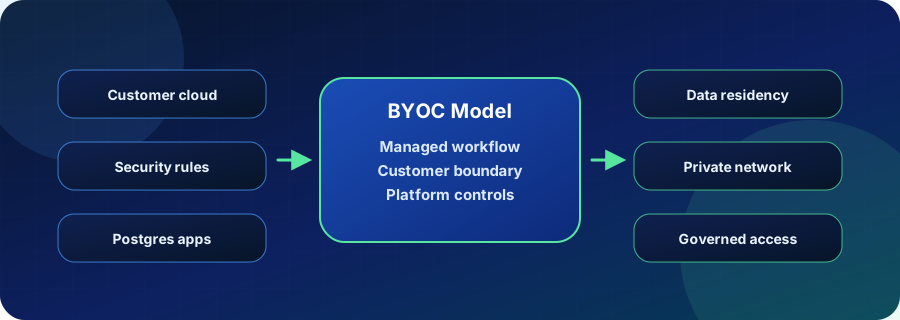
How BYOC Works
In a BYOC model, the customer keeps infrastructure in their own cloud account, VPC, project, or private environment. The vendor provides management software, lifecycle automation, or an operational control plane around that environment.
For databases, this matters because storage, network paths, identity rules, backup policies, and compliance controls often need to line up with the customer security model. BYOC should reduce operational burden without weakening those boundaries.
Where Teams Use BYOC
BYOC is common in organizations that want a managed platform workflow but cannot accept a fully vendor-hosted data path. It is especially relevant for regulated industries, enterprise platform teams, and private-cloud or sovereign-cloud initiatives.
Common patterns include:
- running Postgres workflows inside an existing cloud account
- keeping data inside approved regions or networks
- aligning with existing IAM, VPC, and audit controls
- using enterprise cloud commitments while adding platform automation
- standardizing database branches and clones without moving data ownership
Need managed Postgres workflows inside your own cloud boundary? Vela is designed for teams that want platform-level branching and cloning while keeping deployment control in their environment. Explore Vela BYOC
BYOC vs Vendor Cloud vs Self-Managed Postgres
BYOC sits between a pure vendor-hosted service and a fully self-managed database stack.
| Approach | Who controls infrastructure | Best fit | Common limitation |
|---|---|---|---|
| Vendor-hosted DBaaS | Vendor cloud account | Simple managed database consumption | Data and network placement may not match every enterprise rule |
| Self-managed Postgres | Customer team | Maximum control and custom operations | Requires platform and DBA capacity |
| BYOC platform | Customer cloud with vendor platform layer | Control-sensitive teams that still want managed workflows | Requires clear responsibility boundaries |
| Vela BYOC workflow | Customer boundary plus Vela database lifecycle workflows | Branching, cloning, QA, and governed Postgres environments | Requires account, network, and access planning |
How BYOC Relates to Vela
Vela uses the BYOC model when teams want a Postgres platform experience while keeping infrastructure and data inside their own cloud or security boundary. That makes BYOC relevant to branches, clones, and production-like environments that need to respect enterprise controls.
The useful outcome is not just deployment placement. It is the ability to combine self-serve database workflows with access, retention, and governance rules that match the customer environment.
Operational Checks
Before adopting a BYOC Postgres platform, verify the shared responsibility model:
- confirm where data, backups, logs, and metadata live
- map network paths, private connectivity, and firewall rules
- define who operates upgrades, incidents, and support boundaries
- confirm IAM, SSO, audit, and compliance requirements
- test branch and clone workflows inside the intended cloud boundary
Related Vela Reading
Start with How Vela Works, Database Branching, Branch per PR, and the Vela articles library. For adjacent glossary terms, review Database Branching, Copy-on-Write (COW), Clone (Database Clone), Vela.