AI database branching means creating isolated database branches for AI workflows that need realistic Postgres data. It is useful when agents, RAG systems, embedding pipelines, or generated SQL need to be tested without writing to production.
AI systems often fail at the boundary between model output and real data behavior. A branch gives teams a controlled place to test that boundary with production-like schema, data distribution, and permissions.
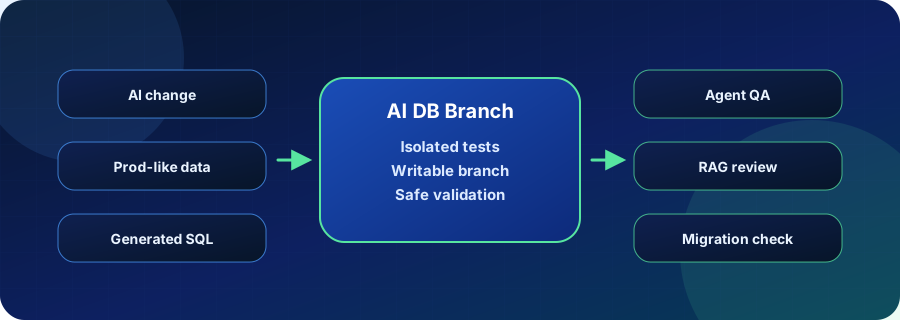
How AI Database Branching Works
AI database branching starts from a trusted Postgres baseline and creates an isolated branch for an AI workflow. The workflow can test retrieval changes, generated SQL, schema changes, or data transformations without affecting the source database.
The branch should still follow data access policies. If the branch uses production-like data, teams need retention, masking, audit, and cleanup rules that match the sensitivity of the source.
Where Teams Use AI Database Branching
Teams use AI database branching when AI features need realistic database context. It is especially useful for agent evaluation, RAG pipeline changes, SQL generation, migration review, and AI-assisted QA.
Common patterns include:
- testing agent-generated SQL before execution in production
- validating RAG retrieval and metadata filters
- checking embedding refreshes against production-like data
- running AI QA workflows on isolated branches
- rehearsing schema changes proposed by coding agents
Need safer AI tests against real Postgres behavior? Vela branches let teams isolate AI workflows while preserving production-like database context for validation. See Vela database branching
AI Database Branching vs Synthetic AI Test Data
Synthetic fixtures are useful early, but they often miss production-like edge cases.
| Approach | How it tests AI workflows | Best fit | Common limitation |
|---|---|---|---|
| Synthetic fixtures | Small generated test dataset | Early prototyping | Misses production-like distribution and permissions |
| Shared [staging database](/postgres-staging-environment/) | One long-lived environment | Simple team workflows | Drift and cross-team interference |
| AI database branch | Isolated branch from a trusted baseline | Agent, RAG, SQL, and migration validation | Needs data access and cleanup rules |
| Vela branch workflow | Production-like branches with lifecycle control | Repeatable AI workflow validation | Requires branch governance |
How AI Database Branching Relates to Vela
Vela makes database branching a first-class Postgres workflow. For AI teams, that means agents, retrieval pipelines, and generated SQL can be tested in isolated environments before production use.
This keeps AI experimentation closer to real data behavior without removing the operational boundaries that database teams need.
Operational Checks
Before adopting AI database branching, verify:
- which AI workflows can create and write to branches
- how production-like data is masked or governed
- whether generated SQL is reviewed before promotion
- how embedding and retrieval changes are evaluated
- how temporary AI branches are retained and deleted
Related Vela Reading
Start with Postgres for AI Applications, Agentic Databases, Database Branching, and the Vela articles library. For adjacent glossary terms, review Agent-Ready Postgres, RAG with Postgres, Database Branching, Postgres for AI Agents.