AI data governance for Postgres defines how AI systems can access, test, transform, and audit PostgreSQL data. It matters because AI workflows often need realistic context, but that context may include sensitive application or customer data.
Good governance does not only say yes or no to AI. It creates safe workflows: branches for testing, permissions for retrieval, controls for generated SQL, audit trails for changes, and cleanup rules for temporary environments.
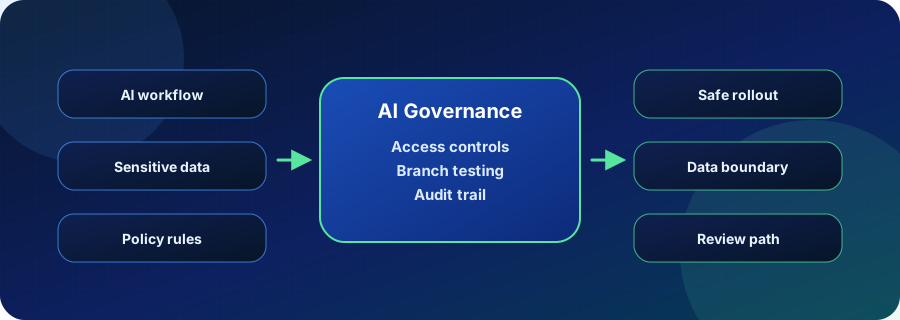
What AI Data Governance for Postgres Means
AI data governance for Postgres combines data access rules, workflow controls, and operational evidence. It should define which data AI systems can use, where experiments run, how outputs are reviewed, and how risky changes are isolated.
Postgres teams need this because AI workflows can involve SQL generation, retrieval, embedding refreshes, schema changes, and agent tool calls. Each step can affect data safety if it is not tested and governed.
Where Teams Use AI Data Governance for Postgres
Teams use AI data governance when building RAG systems, AI agents, internal copilots, analytics assistants, or coding agents that interact with application databases.
Common patterns include:
- limiting which branches AI workflows can read or write
- testing AI-generated SQL outside production
- auditing retrieval and embedding changes
- enforcing tenant and permission filters before model context
- cleaning up temporary AI experiment databases
Need safer governance for AI workflows on Postgres? Vela branches help teams isolate AI tests and keep production-like validation inside controlled workflows. Explore Vela for AI applications
AI Data Governance vs Basic Database Permissions
Permissions are necessary, but AI workflows also need lifecycle and testing controls.
| Approach | What it controls | Best fit | Common limitation |
|---|---|---|---|
| Basic database permissions | Who can read or write tables | Core access control | Does not cover AI workflow lifecycle |
| Prompt or tool policy | What an AI tool should do | Application-level guardrails | May miss database-side risks |
| AI data governance for Postgres | Data, branches, SQL, audit, and cleanup | Production AI rollout | Requires cross-team ownership |
| Vela branch workflow | Isolated validation environments | Safe tests with production-like data | Needs clear access and retention rules |
How AI Data Governance for Postgres Relates to Vela
Vela is relevant because branches and clones can become governed places for AI workflows to run before production. Teams can test retrieval, generated SQL, and schema changes without giving AI systems unrestricted access to the main database.
This supports a practical governance model: use production-like context where needed, but keep experiments isolated, observable, and disposable.
Operational Checks
Before adopting AI data governance for Postgres, verify:
- which AI systems can access which data classes
- whether experiments run in branches or production
- how generated SQL and schema changes are reviewed
- how retrieval context is filtered and audited
- how temporary AI branches and embeddings are cleaned up
Related Vela Reading
Start with Postgres for AI Applications, Agentic Databases, Database Branching, and the Vela articles library. For adjacent glossary terms, review AI Database Branching, Agent-Ready Postgres, Sovereign Postgres, Postgres for AI Agents.