AI applications demand fast iteration, strong consistency, and rich data models, which is why a free Postgres database is still the default backend for many teams. Postgres handles structured data, transactions, and extensions in one engine, which keeps AI systems simpler and easier to evolve.
Free and open source Postgres platforms lower entry barriers while preserving long‑term flexibility. The goal is to start quickly without committing to a proprietary stack you can’t unwind later, and to keep upgrade paths open as your workload scales.
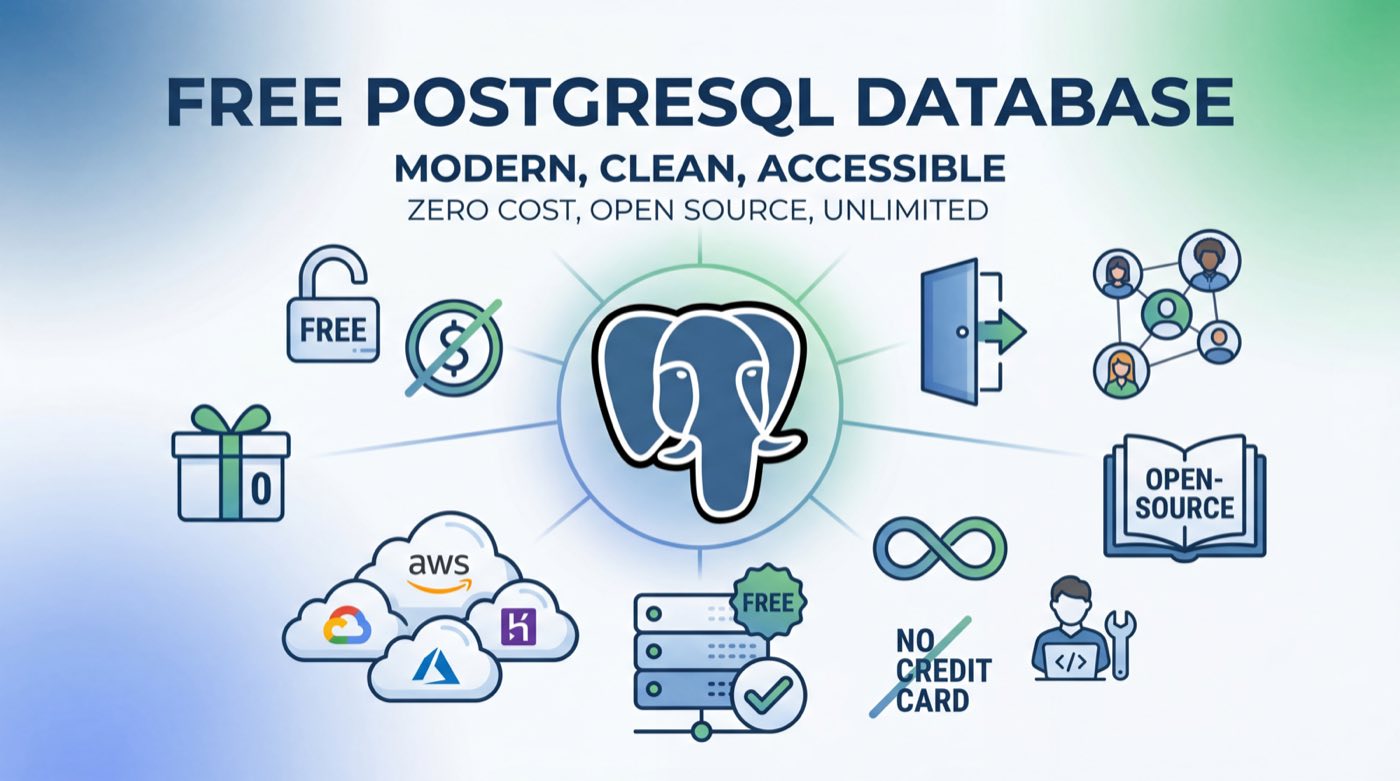
Why Postgres Fits AI Backends
Postgres supports structured data, vectors, and transactional workloads in one engine. This simplifies AI system architecture because feature storage, metadata, and operational state can live together with strong consistency. For a deeper architecture view, see Postgres for AI applications.
- Transactional guarantees for prompt history and agent state
- Flexible schemas for evolving data models and embeddings
- Extensions that bring vector search closer to the data
- Operational tooling and ecosystem maturity
Challenges with Free Postgres Setups
Raw Postgres requires careful tuning, backups, and scaling strategies. AI workloads expose these gaps quickly through bursts of concurrent reads and writes, and through workloads that mix OLTP and vector search.
Create your Postgres backend in 90 seconds.
Launch a production-ready Postgres stack with branching and instant clones.
Start in 90 secondsPlatform Layers Matter
Modern teams look beyond the database binary. They need cloning, isolation, and environment management built in so experimentation does not disrupt production systems. That is why many teams move from “just Postgres” to a platform model that includes branching and fast environment creation.
Vela as a Free Postgres Database Foundation
Vela builds on open source Postgres while providing out-of-the-box tooling and extensions that are ready in minutes. Teams can start free and scale without replatforming, using branching to create temporary environments for experiments and QA. Try the free sandbox.
Instant database clones accelerate model testing and prompt iteration. Instead of waiting for a staging environment, teams can spin up a clone for each experiment and shut it down when the run finishes. Learn more about branching and Postgres BaaS.
Free is only free if the operational cost stays low — automation and cloning are what keep it that way.
Designing AI Backends for the Long Term
Choosing an OSS‑first Postgres platform ensures adaptability as AI workloads evolve. Look for platforms that preserve standard Postgres interfaces while reducing the operational load of scaling and experimentation, especially when the database becomes the system of record for AI applications.