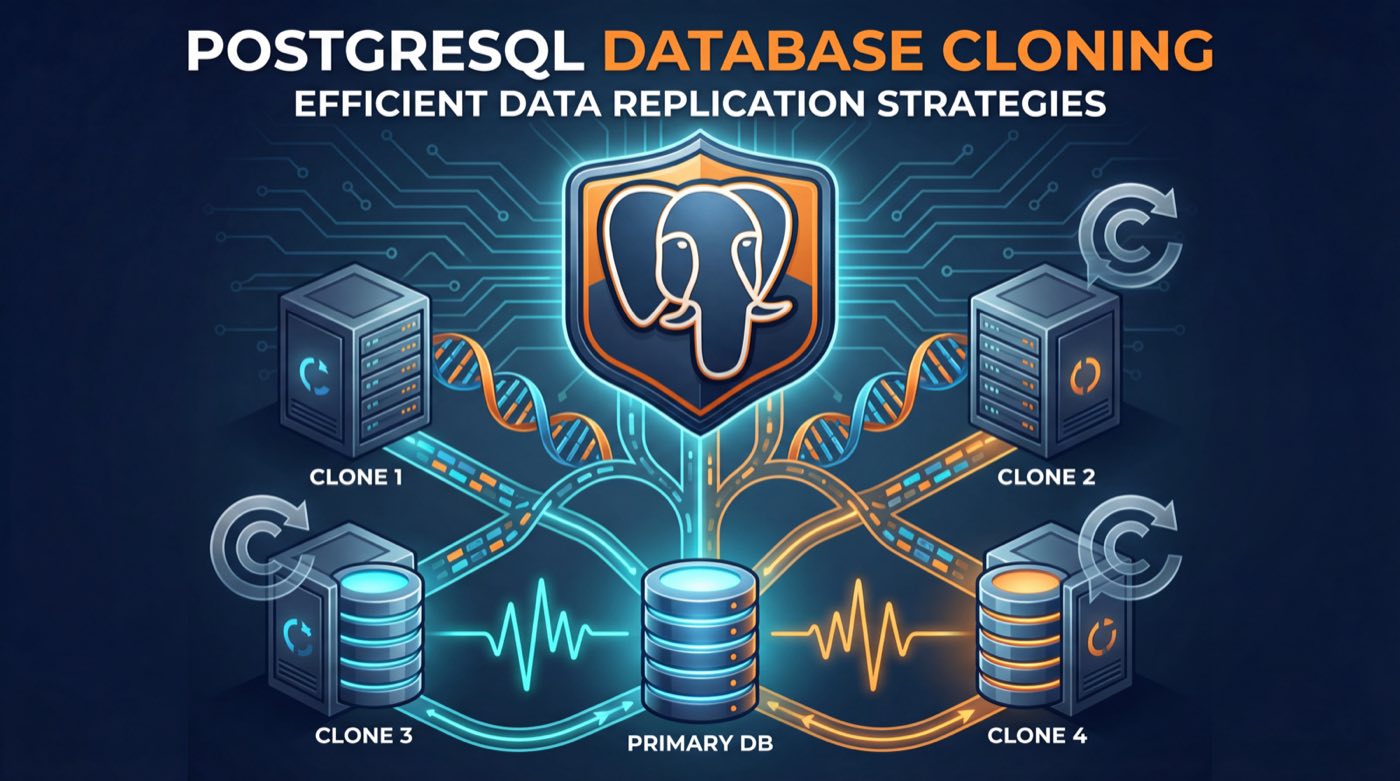
PostgreSQL cloning used to mean long restores and heavyweight copies. Today, teams expect clones on demand for CI, QA, demos, and incident response.
Cloning solves a different problem than backups. Backups are for recovery. Clones are for safe iteration before production.
Open source tools can get you part of the way there. They rely on snapshots, physical backups, replication, or filesystem tricks.
This guide covers the best open source options for PostgreSQL cloning, where they work well, and where modern workflows hit limits.
Why PostgreSQL Cloning Matters
Teams need production-like data to test migrations, validate analytics changes, and reproduce bugs. Shared staging databases slow everyone down.
Clones give each workflow an isolated environment. The faster clones are created, the more safely teams can iterate.
The hard part is time and cost. Full copies are expensive. Restores are slow. That is why most “cloning” strategies are built on snapshots or replication.
Open Source PostgreSQL Cloning Options
These approaches enable cloning through backups, snapshots, or replication. Each has tradeoffs around speed, isolation, and operational complexity.
1. pg_basebackup + restore
pg_basebackup creates a physical copy of a PostgreSQL data directory. Restoring it yields a new clone.
It is reliable but slow for large datasets. Clones take minutes to hours and consume full storage.
2. pgBackRest restore to new instance
pgBackRest can restore a backup into a new data directory, effectively creating a clone.
It supports incremental backups and parallel restores, but cloning still depends on full restore time.
3. WAL-G + restore
WAL-G stores backups in object storage and can restore to a new node. This is common in cloud-native setups.
It is flexible and efficient but still tied to restore time and storage costs.
4. Filesystem snapshots (ZFS / LVM)
Snapshot-capable filesystems like ZFS or LVM can create fast point-in-time snapshots of PostgreSQL data directories.
With careful coordination, snapshots can be turned into clones quickly. The challenge is operational complexity and portability.
5. Simplyblock (copy-on-write storage)
Simplyblock provides high-performance distributed NVMe/TCP storage with copy-on-write capabilities that power instant clones and database branching workflows.
It is designed for modern, cloud-native Postgres platforms that need fast snapshots without full data copies.
6. Logical replication for seeded clones
Logical replication can seed a new database and keep it in sync until cutover. This is used for “clone-like” environments.
It is effective but requires coordination for schema changes and conflict handling.
7. pglogical
pglogical extends logical replication with filtering and bidirectional sync. Some teams use it to maintain “clones” for testing.
It adds flexibility but also more operational overhead.
8. Kubernetes volume snapshots
In Kubernetes, CSI volume snapshots can create fast copies of PostgreSQL volumes.
This enables quick clone creation but depends on storage provider consistency and careful application quiescing.
For a higher-level view, see Postgres BaaS and How Vela Works: Branching.
Where These Approaches Work Well
Open source cloning approaches work best when clone frequency is low and restore time is acceptable.
- Occasional QA or staging refreshes
- Planned migrations and cutovers
- Disaster recovery testing
With enough storage and patience, these methods are reliable.
Create your Postgres backend in 90 seconds.
Launch a production-ready Postgres stack with branching and instant clones.
Start in 90 secondsWhere Cloning Breaks Down
Modern teams need clones constantly: per pull request, per experiment, per migration rehearsal.
Restore-based cloning is too slow. Full copies are too expensive. Shared staging databases create risk and coordination overhead.
Cloning becomes a bottleneck instead of an enabler.
From Clones to Branches
Modern PostgreSQL platforms treat cloning and branching as core primitives. Copy-on-write storage enables instant clones with minimal overhead.
Branches replace shared staging databases. Each workflow gets isolation without waiting on restores.
This is how database workflows catch up to modern CI and feature development.
Where Vela Fits
Vela builds on PostgreSQL and storage-level copy-on-write to deliver instant clones. Branches behave like full databases and can be created in seconds.
You can create a clone per PR, per migration, or per incident investigation without waiting for restores.
Vela runs in your cloud, integrates with Kubernetes, and keeps costs predictable, engineered on Simplyblock’s high-performance distributed NVMe/TCP storage. Learn more in How Vela Works or try the free sandbox.
How This Compares to Other Platforms
Managed services like Supabase OSS and Neon OSS provide basic cloning or branching, but often with limits on isolation or performance.
Self-hosting restores control but increases operational load. Vela balances both by delivering a platform workflow in your own cloud.
Choosing the Right Cloning Strategy
Open source tools remain essential for backups and recovery. Cloning is about workflow speed and isolation.
If you need occasional clones, restore-based tools may be enough. If you need frequent clones, platform support matters.
Modern teams need both.
Final Thoughts
PostgreSQL cloning tools are useful but limited by restore time and storage overhead.
The future is instant cloning and branching. That is how teams iterate safely without slowing down.