Open source has always been the backbone of PostgreSQL, but in 2026 the ecosystem is more mature than ever. The best tools now cover not only backups and replication, but also observability, CI workflows, and safe iteration at scale, which means teams can build a modern database platform without locking into proprietary stacks.
The challenge for teams is not a lack of options. The challenge is choosing the right combination of tools for their workflow while keeping operations manageable and costs predictable as data size, query volume, and operational complexity grow.
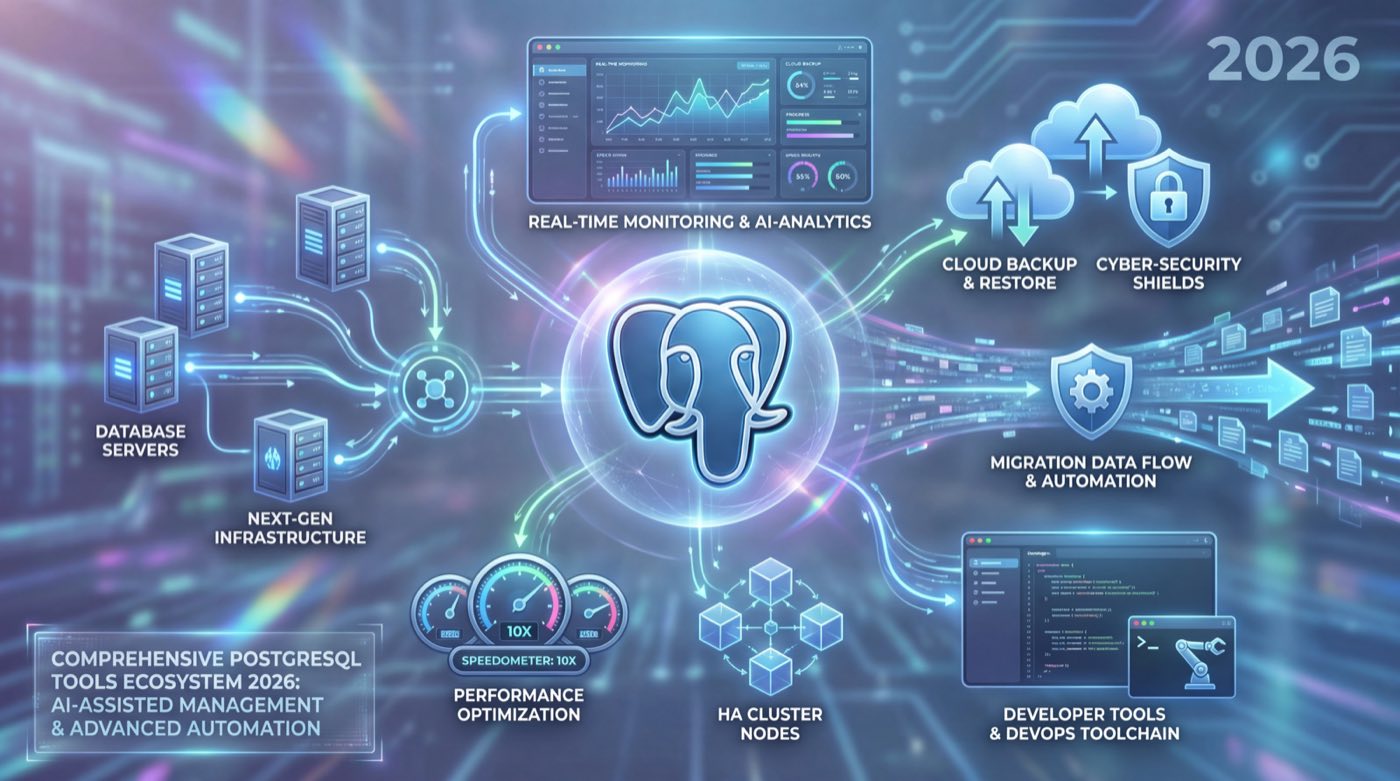
This guide highlights the 10 best open source tools for PostgreSQL in 2026 and links to deeper dives we have published on backup, migration, cloning, performance, HA, and observability so you can go deeper on the areas that matter most to your team.
1. PostgreSQL core utilities (pg_dump, pg_restore, pg_basebackup)
PostgreSQL’s built-in tooling remains essential. pg_dump and pg_restore handle logical backups and migrations, while pg_basebackup powers physical clones and replication workflows.
These tools are reliable but scale linearly with data size, which is why many teams layer additional tooling on top.
2. Vela (workflow safety + branching)
Vela provides instant clones and branching out of the box, engineered on Simplyblock’s high-performance distributed NVMe/TCP storage.
It complements open source tools by making it safe to test migrations, performance changes, and schema experiments without sharing staging environments. Try the free sandbox.
3. pgBackRest
pgBackRest is the most popular open source backup framework for PostgreSQL. It supports compression, encryption, and incremental backups with strong restore tooling.
If you want a deeper view, read Best Open Source Tools for PostgreSQL Backup and Restore.
4. WAL-G
WAL-G modernizes PostgreSQL backups for cloud environments by streaming WAL files to object storage. It is a strong fit for Kubernetes and ephemeral nodes.
WAL-G is best when durability and restore automation are critical but you still want OSS flexibility.
Create your Postgres backend in 90 seconds.
Launch a production-ready Postgres stack with branching and instant clones.
Start in 90 seconds5. Patroni
Patroni is the most widely adopted HA framework for PostgreSQL. It manages failover and leader election using a distributed consensus backend.
See Best Open Source Tools for PostgreSQL High Availability for a deeper comparison.
6. pg_stat_statements
pg_stat_statements is the fastest way to identify expensive queries. It provides cumulative query performance statistics inside PostgreSQL.
Pair it with EXPLAIN or auto_explain to understand why queries are slow.
7. Prometheus + postgres_exporter
Prometheus with postgres_exporter is the default OSS stack for PostgreSQL metrics. It provides time-series visibility and alerting when tuned correctly.
For a complete observability perspective, see Best Open Source Tools for PostgreSQL Monitoring & Observability.
8. pgbench
pgbench is PostgreSQL’s built-in benchmark tool. It helps teams measure performance changes, especially when paired with production-like data.
Read Best Open Source Tools for PostgreSQL Performance Tuning for more.
9. Logical replication (built-in)
Logical replication powers low-downtime migrations and data sync. It is built into PostgreSQL and can be extended with tools like pglogical.
For migration workflows, see Best Open Source Tools for PostgreSQL Data Migration.
10. ZFS / filesystem snapshots
Snapshot-capable filesystems like ZFS or LVM enable fast point-in-time clones. They are powerful but operationally complex at scale.
For cloning strategies, see Best Open Source Tools for PostgreSQL Cloning.
Choosing the Right Stack in 2026
The right toolset depends on how often you migrate, how many environments you run, and how much isolation your teams need. Most companies use a mix of core PostgreSQL utilities, HA tooling, and observability stacks.
What changes in 2026 is the expectation for speed and safety. Teams want backups, but they also want instant clones and workflow isolation without costly restores, which is why platforms that combine storage-level copy-on-write with Postgres compatibility are winning.
Final Thoughts
PostgreSQL’s open source ecosystem continues to lead the database world. With the right tooling, teams can build fast, resilient, and safe workflows that scale with modern application demands.
Related Reading
- Best Open Source Tools for PostgreSQL Backup and Restore
- Best Open Source Tools for PostgreSQL Data Migration
- Best Open Source Tools for PostgreSQL Cloning
- Best Open Source Tools for PostgreSQL Monitoring & Observability
- Best Open Source Tools for PostgreSQL High Availability
- Best Open Source Tools for PostgreSQL Performance Tuning